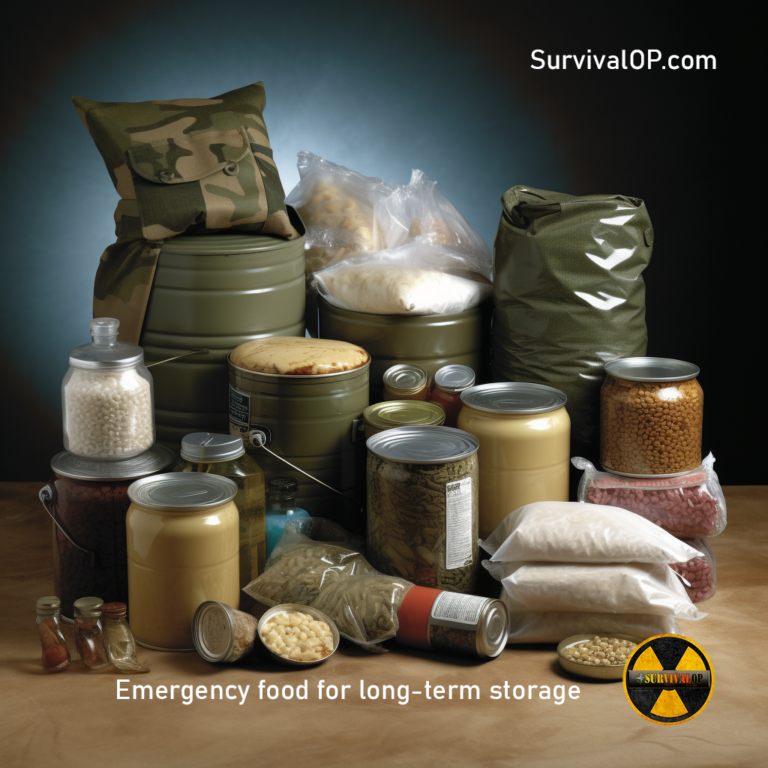
How long emergency food lasts depends on the ingredients, processing method, package integrity and storage conditions. There is no single food that remains safe forever simply because a manufacturer prints a long shelf-life claim. The smarter strategy is to combine ready-to-eat foods for immediate disruptions with well-protected dry and packaged staples for longer storage.
Affiliate disclosure: SurvivalOP may earn a commission if you make a purchase through qualifying links, at no additional cost to you. Product details and availability can change; confirm specifications with the retailer.
Emergency food types compared
| Type | Main advantage | Storage or use caution |
|---|---|---|
| Commercial freeze-dried meals | Often sold with long manufacturer storage claims | Keep sealed, cool and dry; water and fuel often required |
| Commercial dehydrated meals | Compact and light for larger reserves | Water, cooking time and instructions vary by product |
| Canned beans, vegetables, fish and soups | Affordable and often ready to eat | Avoid damaged, bulging or leaking cans; rotate stock |
| Rice, pasta and dried beans | Low cost per calorie | Protect from moisture and pests; some foods need significant cooking fuel |
| Peanut butter, bars and crackers | Convenient short-term no-cook calories | Fat content and moisture influence shelf life; rotate more often |
Are 20- or 25-year food-storage claims realistic?
Certain commercial emergency-food products are marketed as lasting 20 to 25 years under specified conditions. That is a manufacturer storage claim, not a promise that every package lasts that long in any environment. Read the label and warranty, protect packaging, avoid prolonged heat exposure and inspect supplies regularly.
For example, 4Patriots currently markets its 3-month kit with a 25-year shelf-life claim subject to proper storage, and its product page warns that excessive heat or package damage may reduce shelf life. See the manufacturer’s storage conditions for the exact product. The same principle applies to other emergency-food companies.
Best-by dates and actual food safety
The USDA explains that many date labels on shelf-stable foods are related to quality rather than an automatic safety cutoff. Infant formula is a special case with stricter rules. Do not ignore leaking, bulging, badly rusted or damaged packaging, contamination or signs of spoilage just because a date is still in the future. Follow product-specific storage and handling instructions. USDA food-dating guidance provides more context.
Where to store a long-term emergency pantry
- Choose a clean, dry interior location with a relatively stable, cool temperature.
- Keep boxes and pouches off wet floors and out of direct sunlight.
- Label the date bought and the earliest best-by or rotation date.
- Do not count on a hot attic, shed or garage for a 25-year storage claim.
- Inspect for pests, water damage, damaged seals, broken jars and swollen cans.
Which foods work when the power and water are off?
A kit made mostly of dehydrated foods is less convenient if safe water or cooking fuel is unavailable. For the first 72 hours, plan ready-to-eat staples such as canned fish, peanut butter, shelf-stable drinks, crackers, dried fruit and foods appropriate for your family. FoodSafety.gov’s emergency guidance recommends foods requiring little or no cooking or refrigeration.
The CDC recommends at least one gallon of water per person per day for the first three days, with more where needed. Consider extra clean water for rehydrating meals; compare the exact recipe instructions.
When should you choose a commercial food kit?
A dedicated kit can be helpful if you want packaged meals you can store for years with limited rotation. Compare its total calories, recipes, allergens and preparation water instead of choosing by the largest serving count. Our Emergency Food Supply Guide and survival food kit comparison walk through those decisions.
Browse My Patriot Supply Emergency Food Kits — Compare currently listed durations, ingredients and prices directly with the retailer.
Check the 4Patriots 3-Month Kit Offer — This link is specifically for the 3-month offer, not the 72-hour kit. Confirm the product and checkout terms before ordering.
Frequently asked questions
Does freeze-dried food last longer than canned food?
Some commercially packaged freeze-dried products have much longer stated shelf lives, but the comparison depends on the exact product and storage conditions. Canned food is often more convenient for immediate emergencies because it can be eaten without adding water.
Can emergency food be stored in the garage?
A garage with significant summer heat or fluctuating humidity is a poor choice for most long-term foods. Follow the manufacturer’s temperature and moisture requirements.
How often should I inspect my supplies?
Review the pantry at least twice a year, check packaging and rotate shorter-life foods into regular meals before replacing them.
Helpful next steps: Long-term storage plan · Food safety during outages