
Affiliate disclosure: SurvivalOP may earn a commission if you buy through qualifying product links, at no additional cost to you. Compare actual contents, fit, availability and costs before ordering.
Doomsday Survival Kit List
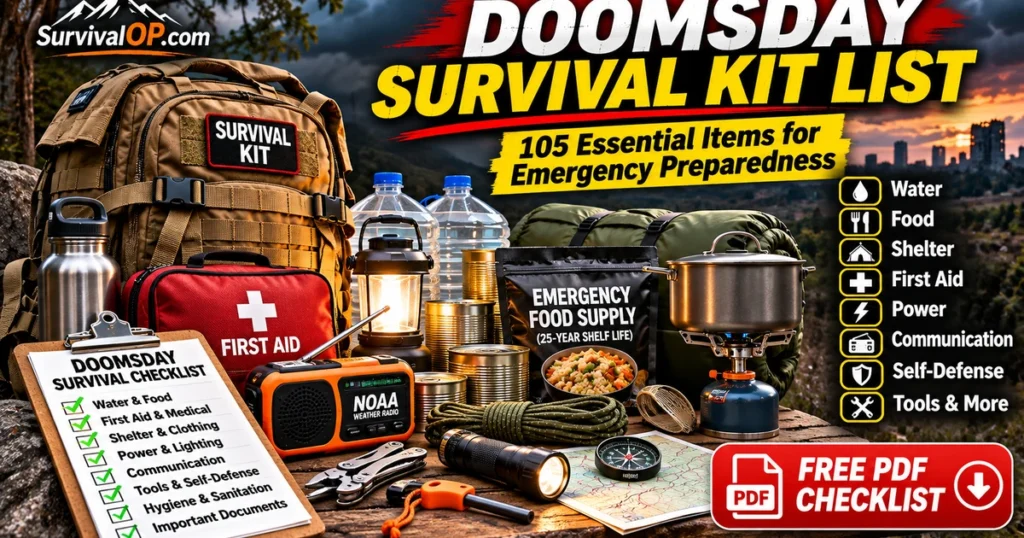
A practical 105-item interactive checklist, custom additions, and a free printable PDF for a ready-to-go bag and a longer home reserve.
A 72-hour kit is a starting reserve, not a guarantee that help will arrive in three days. Follow local emergency instructions, including evacuation orders.
A doomsday survival kit is a collection of essential, accessible supplies that helps you manage a serious disruption or evacuate safely. The best kit is not necessarily the biggest or most expensive. It contains safe water, practical food, necessary medicines, weather protection, reliable communications and an actual plan you can follow.
The older version of this article mixed emergency packing with unrelated sports and disaster-cleanup advice. This replacement concentrates on what to pack, how to divide supplies, how much water to store, how to test the weight, and how to maintain the kit.
For broad household preparedness, use the Complete Preppers List. For a full supplies inventory rather than a ready-to-carry kit, see the Ultimate Prepper Supplies List.
Build Three Layers, Not One Overloaded Backpack
It is rarely practical to carry all your household emergency supplies in one backpack. Build modular kits based on what you may actually need to move.
72-Hour Go-Bag
A portable bag with identification, critical medicines, water you can carry, food you can eat, weather protection, first aid, a radio/phone backup and basic hygiene items.
Test the packed weight on a short walk. A kit that you cannot safely carry is not a useful evacuation bag.
See the 72-hour packing guide7–14-Day Home Reserve
Store heavier water supplies, additional food, sanitation, lighting, weather protection and backup power in clearly labeled household bins.
Two weeks is an expansion goal where space and budget allow, not a promise that conditions will be safe for sheltering at home.
Review the full supply inventorySpecial Needs Module
Add supplies for infants, seniors, pets, accessibility equipment, medical requirements and local hazards. Keep essential documents ready.
A medical-device backup plan should be made with the care team and device supplier—not assumed from a generic battery label.
Build the wider emergency planFirst Priorities in a Serious Emergency
1. Follow official instructions
Assess the hazard. Leave immediately if ordered to evacuate. Do not enter floodwaters or damaged structures, and do not delay a necessary departure to finish packing.
2. Protect essential health needs
Keep medications, medical information, communication aids, safe water, appropriate food and weatherproof clothing accessible.
3. Communicate your location
Use local alerts, a charged phone, a weather radio and a written family contact plan. Choose a meeting location before an emergency.
4. Match supplies to the scenario
An evacuation bag and a home power-outage reserve have different weight, water, sanitation and electricity requirements.
Safety: Do not use gasoline or diesel generators, charcoal grills, or outdoor camp stoves inside homes, garages, tents or enclosed spaces. Use fuel-burning equipment only where its instructions permit. See CDC carbon-monoxide safety guidance.
How Much Emergency Water Should You Store?
Start with one US gallon per person per day for drinking and basic sanitation, then increase for hot weather, illness, pets, food preparation and medical needs. It is a planning baseline, not a rigid maximum. Keep most of this reserve at home or in a vehicle rather than trying to carry several gallons in a go-bag. See Ready.gov kit guidance.
Calculation: people × days × 1 US gallon. This doesn’t include additional needs. Never rely on filtering or boiling to remove hazardous chemicals from contaminated water.
For a longer water plan, evaluate storage containers, appropriate filtration or purification equipment, and replacement schedules. Compare Alexapure water-filtration options as an optional household setup, and check performance documentation against your water source.
Interactive Doomsday Survival Kit Checklist
Mark what you have, filter what you still need, and add household-specific items. Your progress saves in this browser when storage is available. No account or plugin is needed.
Checking boxes tracks only this inventory. It is not a certification that a kit is safe or complete.
01. Water & safe hydration
Both kits · 10 items02. Food & cooking
Both kits · 10 items03. First aid & medical needs
Both kits · 11 items04. Shelter, bedding & clothing
Both kits · 10 items05. Power, light & communications
Both kits · 10 items06. Sanitation & personal care
Both kits · 9 items07. Documents, cash & family plan
Go-bag · 9 items08. Tools, repairs & personal safety
Go-bag · 9 items09. Vehicle & evacuation
Go-bag · 8 items10. Children, pets & accessibility
As needed · 9 items11. Extended home reserve & maintenance
Home module · 10 itemsMy Custom Supplies — Add Unlimited Items
Use this for prescriptions, mobility supplies, pet care, local risks or anything else your household needs.
How to Pack, Store and Maintain Your Survival Kit
Pack in retrieval order, not alphabetic order
Put medications, identity documents, phone charging, first aid and weather protection in easy-to-reach compartments. Keep water and dense supplies close to your back and test load balance. Do not pack more than you can safely carry.
Keep the home reserve in clearly labeled bins
Use dry, stable storage away from excessive heat, moisture and pests. Label each bin with a category, an inspection date and a list of contents. Keep the go-bag accessible near your normal evacuation route, but not in a place where it may be damaged by flooding or heat.
Review supplies every six months
Rotate foods, inspect seals, replace expired consumables, test batteries, recharge power banks, check clothing sizes and update phone numbers. Test the bag on a realistic short walk or vehicle-loading drill. Check any medication plan with your clinician or pharmacist.
Plan for evacuation instead of assuming you can shelter indefinitely
Identify destinations, alternate routes, accessible shelter options, pet policies and a family reunification plan. Follow official evacuation orders; a stocked kit does not make an unsafe building or area safe.
Planning a water/sewer outage? Use Emergency Sanitation Without Running Water. For a longer-term disaster strategy, see the Doomsday Prep List.
Helpful Gear for Building the Kit
These are optional shopping resources, not substitutes for a realistic personal plan. Start with items you already own, then fill verified gaps. Check current availability, actual contents, dietary needs and packed weights.
Shelf-Stable Emergency Meals
Useful for supplementing a pantry reserve. Compare calories per person, allergens, shelf life, and how much safe water and heat each meal requires. Keep no-cook food too.
Browse Emergency Food OptionsCompact First Aid Kit
A compact kit may fit in a go-bag, but first aid contents should match training and personal requirements. Add medication continuity separately.
See SurviveX Small First Aid KitThree-Month Emergency Food Option
Consider only for an extended home reserve, not a lightweight go-bag. Compare total calories, food variety, dietary restrictions, water requirements and current offer terms before buying.
Review 4Patriots Food-Kit OfferHome Gravity Water Filtration
Useful for evaluating a household water-treatment setup. Confirm the exact system’s contaminant-reduction claims and whether it suits your local water safety concerns.
Explore Alexapure FiltrationFor backup electricity, calculate actual watt-hours and surge needs before buying any power station. See the Power Outage Preparedness Guide; large solar generators belong in a home reserve, not a carry bag.
Doomsday Survival Kit FAQs
What should every survival kit include?
Safe water, practical food, essential medications, first aid, weather protection, lighting, emergency information, contacts and a route to safety. Your local climate, household members and medical needs determine the additions.
Is a 72-hour kit enough?
Three days is a useful starting point, not a guaranteed time to rescue or restored services. Keep a portable kit plus an expanded home reserve when practical. Follow official advice about whether to evacuate.
Should I pack all my emergency water in one backpack?
No. Water is heavy; a US gallon weighs roughly 8.3 pounds before the container. Carry a realistic amount and maintain a separate stored supply or safe replenishment plan.
What is the difference between a prepper supplies list and a survival kit list?
A prepper supplies list inventories household resources and long-term needs. A survival kit list focuses on a portable, organized collection that can be accessed immediately during an emergency.
What about personal security?
Prioritize secure shelter, communication, situational awareness, evacuation routes and lawful personal safety practices. Avoid escalating conflict. If your family chooses additional legal safety equipment, account for training and safe storage rather than treating it as a basic kit requirement.
Does this interactive list save my personal items?
Yes, when your browser permits local storage. You can add unlimited custom supplies, export a JSON backup, import it later, or print your personalized checklist. Other devices will not automatically share your saved list.
Build a Kit You Can Actually Use
Start with water, food, medications, weather protection and a dependable emergency plan. Add specialized gear only when it solves a real gap; review your kit regularly and practice carrying it.
Sources: Ready.gov Build a Kit · CDC Carbon Monoxide Safety · CDC Emergency Water Supply. SurvivalOP is an educational resource, not emergency response or individualized medical advice.


